 Zora
Zora creator coins - vesting allocations and trading rewards
Zora creator coins are tradable profile tokens that reserve half their fixed supply for a creator's five-year vesting allocation and place the rest in trading pools. Each coin contains one billion tokens. In the ZORA-backed V4 configuration, swaps also generate creator rewards in ZORA, separate from the tokens unlocking through vesting.
When can creators claim their allocated tokens?
As their allocation vests, creators can claim progressively unlocked tokens through
claimVesting()
, rather than receiving the entire allocation at launch. A Creator Coin assigns 500 million tokens to this allocation. Another 500 million enter its liquidity pool for immediate trading.
The creator allocation vests linearly over five years. Linear vesting releases an equal share over equal periods of the schedule. Claiming makes the unlocked Creator Coin tokens accessible; selling them would involve a separate market trade. The schedule specifies token availability, without fixing what those tokens will fetch when the creator sells.
Vesting and trading income follow different triggers
Time unlocks the creator's allocated tokens, while swaps generate the fees funding trading rewards under the coin's active configuration. More trading can produce fee income before much of the allocation has vested. Conversely, the vesting schedule can continue during periods without fee-generating trades. A profile view or a post's reach doesn't itself produce a swap fee.
The fee split behind creator earnings
For Creator Coins using hooks at version 2.2.0 or later, the base pool trading fee is 1%, with launch rules handled separately. This fee funds multiple destinations. A trader's fee and the creator's reward therefore describe different amounts, even when both arise from the same swap.
For Creator Coins on hooks at version 2.2.0 or later, the creator share is 50% of total trading fees. At the regular 1% base fee, this corresponds to 0.5% of traded value before payout-currency conversion effects. That relationship uses the trading fee as its starting point; it doesn't apply a percentage to the creator's entire token balance.
The alternative figure, 62.5%, uses market rewards as its denominator. Market rewards comprise 80% of collected fees, so both percentages describe the same creator fee share.
The protocol directs 20% of total fees into new liquidity positions. Referral allocations, the Zora treasury, and the Doppler treasury account for the remaining 30%. The liquidity share stays in the pool rather than becoming a payment the creator can withdraw. Its purpose is to preserve pool depth as trading continues.
Coins running earlier V4 hooks retain their original fee structure unless an owner migrates their liquidity to a hook at version 2.2.0 or later. A fee estimate needs the active hook version to apply the correct creator share.
Follow the creator-reward payout
On Base, a ZORA-backed V4 Creator Coin uses its Uniswap v4 hook to process fees and distribute creator rewards. A swap can deliver ZORA while the creator's separate token allocation continues vesting. Within the version 2.2.0-or-later reward structure, the hook separates liquidity and market rewards, converts market rewards to ZORA, and distributes recipient shares during swap processing.
| Stage within swap processing | Applicable fee and payout rules |
|---|---|
| Collect accrued pool fees | The active hook supplies the applicable trading-fee rules. |
| Separate liquidity and market rewards | The hook uses the liquidity share to mint permanent positions; the remaining share funds recipient rewards. |
| Convert market rewards to ZORA | The ZORA-backed configuration determines the final payout asset. |
| Distribute recipient shares | The configured payout address receives the creator's share automatically. |
A received ZORA reward records fee income from trading. It doesn't show how much of the separate Creator Coin allocation has vested.
Launch timing changes the trading fee
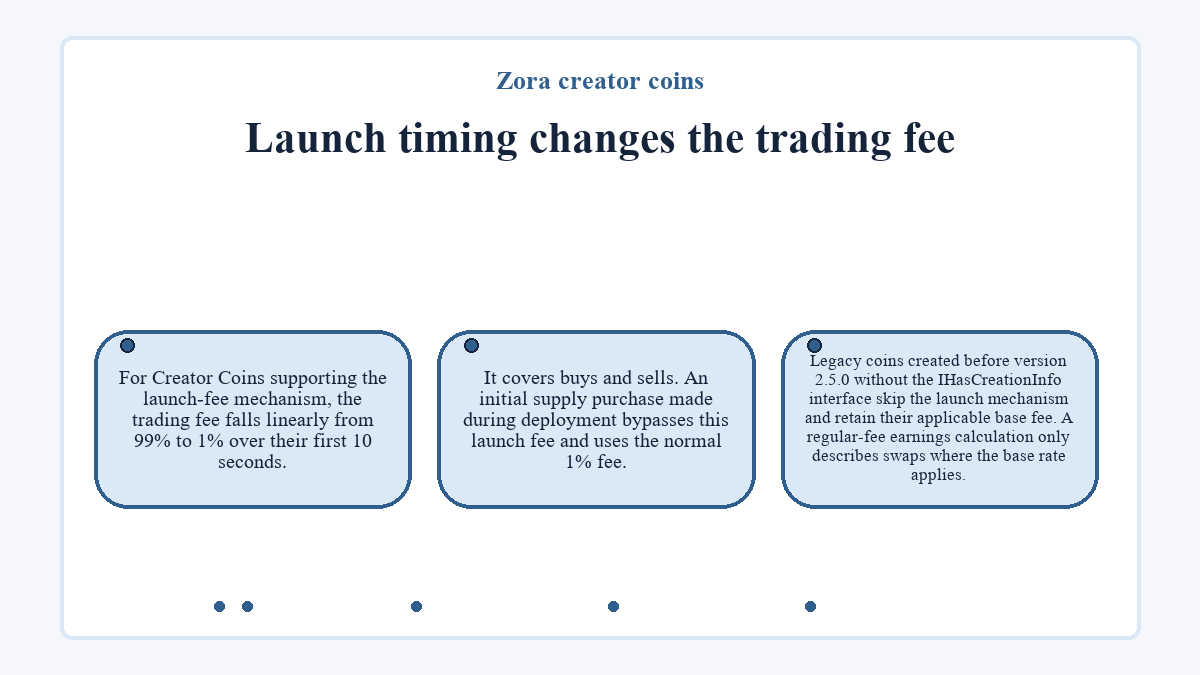
For Creator Coins supporting the launch-fee mechanism, the trading fee falls linearly from 99% to 1% over their first 10 seconds.
It covers buys and sells. An initial supply purchase made during deployment bypasses this launch fee and uses the normal 1% fee. Legacy coins created before version 2.5.0 without the
IHasCreationInfo
interface skip the launch mechanism and retain their applicable base fee. A regular-fee earnings calculation only describes swaps where the base rate applies.
Post markets connect to the profile token
When a Content Coin uses its creator's coin as backing currency, its pool pairs that post-level token with the profile token. The Creator Coin, in turn, pairs with ZORA. Fee conversion from a creator-backed Content Coin can pass through the Creator Coin before reaching ZORA. These pairings connect the markets without requiring their prices to rise together.
Direct contract deployments also support Content Coins backed by ETH or ZORA. The creator-backed arrangement describes one supported configuration, and the actual backing asset determines whether conversion needs an intermediate Creator Coin. For interpreting creator income, a post's own market and the profile's market remain distinct sources of trading activity. Each uses its configured fee and payout rules.
Profile recognition and reward addresses
Within Zora's profile system, one recognized Creator Coin represents a profile, and the profile's username supplies its ticker. Direct contracts permit repeated
deployCreatorCoin()
calls from the same address. The Zora indexer recognizes only the first Creator Coin created for that address. Another successful deployment doesn't establish another recognized profile coin.
Creator identity, management permission, and reward receipt are separate contract roles. The caller of the deployment function counts as the creator. The
owners
array assigns management authority, while
payoutRecipient
identifies the address receiving creator trading rewards. These fields can identify different addresses. Receiving rewards doesn't itself grant management permission.
What to know about Zora creator coins
Does holding a Creator Coin entitle me to its creator's trading rewards?
Holding a Creator Coin doesn't automatically make you the recipient of its creator-reward allocation. The V4 mechanism pays that allocation to the coin's configured payout recipient. Buying tokens changes your token balance; it doesn't, by itself, assign that payout role or create an automatic fee dividend for every holder.
Is claiming vested tokens the same as withdrawing legacy V3 rewards?
A vesting claim releases the creator's allocated coin tokens, while a legacy V3 reward withdrawal takes trading rewards from escrow. The two balances arise from different mechanisms. V4 rewards follow another payout model: the hook converts them to the target currency and distributes them directly, without a separate reward claim.
Which event identifies a V4 creator-reward distribution?
The CoinMarketRewardsV4 event records a market-reward distribution, including the coin, payout currency, and creator payout recipient. Its marketRewards data provides the recipient amounts. This event concerns fees distributed from trading activity, so its figures describe reward payments rather than the remaining vested allocation or the total Creator Coin supply.
Do fee-funded liquidity positions earn another layer of trading rewards?
The liquidity positions reminted from the fee share don't earn future fees. The V4 mechanism locks that share into permanent pool liquidity instead of sending it out as a recipient payment. For Creator Coins using the version 2.2.0-or-later fee structure, this treatment applies to 20% of collected trading fees.
Can a Creator Coin's metadata change after trading begins?
Coin owners can update a Creator Coin's metadata URI through the supported update functions. Token ownership alone doesn't establish that management permission. A transaction signed by an address outside the coin's owners reverts with OnlyOwner. This access rule concerns metadata management, separately from receiving the creator's allocated trading rewards.
Must Creator Coin tickers be globally unique?
Creator Coins don't share the case-insensitive ticker-uniqueness rule enforced for Trend Coins. A familiar Creator Coin ticker therefore doesn't establish a unique coin contract. Zora's recognition of the first Creator Coin for an address is a separate rule: it identifies the profile coin without making its ticker globally unique.
Updated on