 Zora
Zora connects social posts and profiles with tradable coins
Zora is a crypto social app where posts and profiles become tradable coins, and creators can earn rewards from trading activity. Its protocol separates Creator Coins, Content Coins, and Trend Coins, whose allocations and fee rules differ. Creator and Content Coins share trading fees with creators; Trend Coin fees go entirely to the protocol.
Coin markets connect posts, profiles, and trends
Each V4 coin trades against a backing currency in a dedicated Uniswap v4 pool, with rules specific to its coin type. A pool holds paired assets for swaps; its hook is contract code handling functions such as fees and reward distribution. The unified hook operates on Base. Here, backing currency means the asset paired with the coin for trading. It doesn't establish a fixed cash value or a guaranteed sale price. Initial liquidity uses Doppler's multi-curve positioning to spread liquidity across price ranges.
The shared infrastructure supports distinct relationships: a coin representing a profile, a coin associated with one post, or a token centered on a trend.
Profile and post coins allocate supply differently
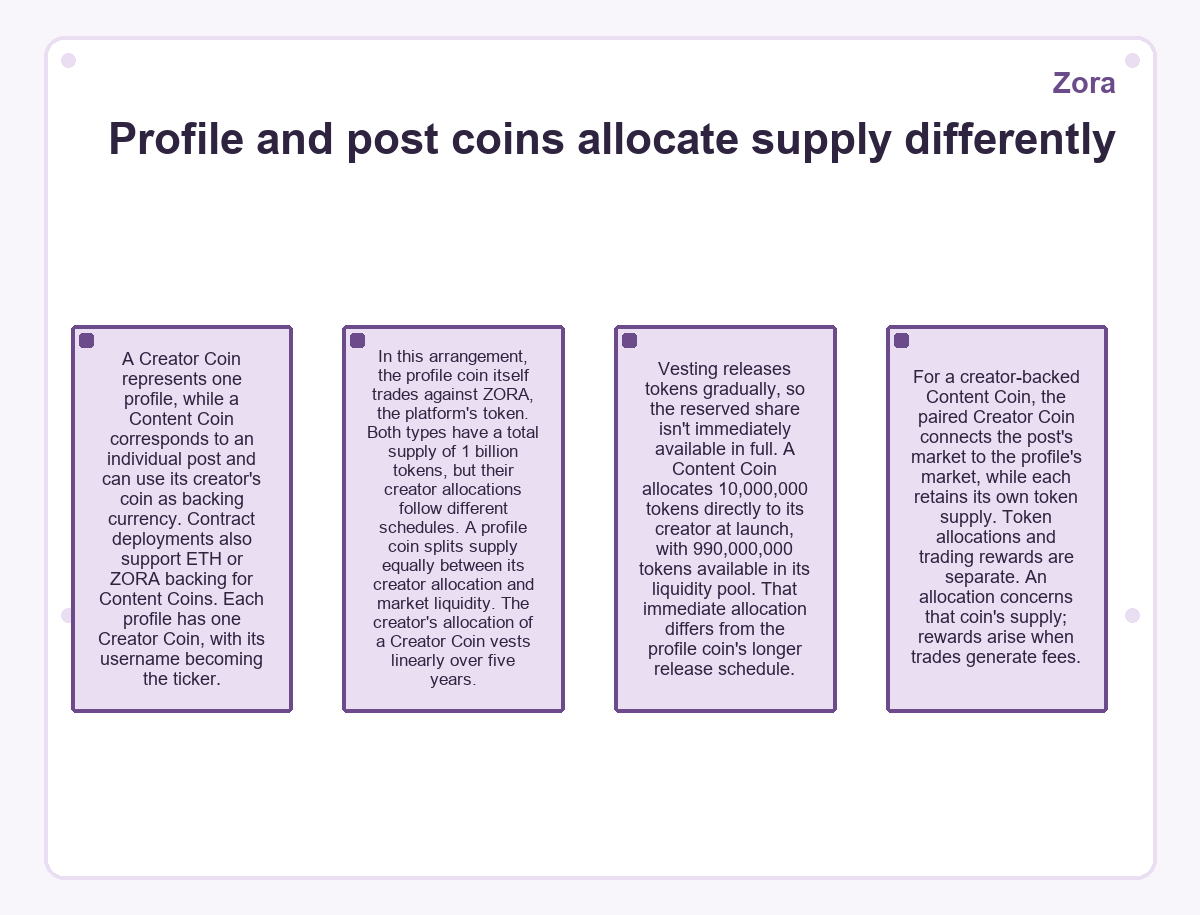
A Creator Coin represents one profile, while a Content Coin corresponds to an individual post and can use its creator's coin as backing currency. Contract deployments also support ETH or ZORA backing for Content Coins. Each profile has one Creator Coin, with its username becoming the ticker. In this arrangement, the profile coin itself trades against ZORA, the platform's token.
Both types have a total supply of 1 billion tokens, but their creator allocations follow different schedules. A profile coin splits supply equally between its creator allocation and market liquidity. The creator's allocation of a Creator Coin vests linearly over five years. Vesting releases tokens gradually, so the reserved share isn't immediately available in full.
A Content Coin allocates 10,000,000 tokens directly to its creator at launch, with 990,000,000 tokens available in its liquidity pool. That immediate allocation differs from the profile coin's longer release schedule. For a creator-backed Content Coin, the paired Creator Coin connects the post's market to the profile's market, while each retains its own token supply.
Token allocations and trading rewards are separate. An allocation concerns that coin's supply; rewards arise when trades generate fees.
What makes Trend Coins different from creator-linked coins?
Trend Coins focus on topics and memes, allocate their entire 1 billion token supply to liquidity, and provide no creator allocation. Their base trading fee is 0.01%, or one basis point, after the applicable 10-second launch window. All collected fees go to the protocol, with no creator or referral share. They also omit the fee-funded liquidity reinvestment used by Creator and Content Coins. These topic coins use ZORA as their backing currency.
ZORA rewards depend on trading fees
Creator and Content Coins using V4 hooks v2.2.0 or later have a 1% base pool fee on trades, outside any applicable launch-fee period. The protocol splits collected fees between the creator, referrers, the protocol, Doppler, and permanent liquidity.
For Creator and Content Coins using V4 hooks v2.2.0 or later, the creator share is 50% of collected trading fees. A further 20% of collected fees remains as permanent pool liquidity.
For the creator-backed markets, the hook converts market rewards through paired currencies before paying them in ZORA. Content Coin fees pass through the paired Creator Coin on that route. This connects post markets, profile markets, and the platform token without making their prices identical. In this V4 model, the hook distributes rewards on each swap without a separate manual claim.
A post's reach doesn't establish fee income; trades in its associated markets generate the fees creators share.
How does the launch fee change a new coin trade?
For coins supporting the launch-fee mechanism, ordinary buys and sells face a fee starting at 99% and falling linearly over 10 seconds. It settles at 1% for Creator and Content Coins, or 0.01% for Trend Coins. The coin type determines the endpoint.
This Sniper Tax raises the cost of immediate launch trading to discourage bots targeting new markets. An ordinary swap immediately after creation can therefore carry a much higher fee than the advertised base rate. The mechanism changes early trading costs; it doesn't stabilize the coin's later market price.
The deployment's initial supply purchase bypasses the launch surcharge and uses a 1% fee. On hooks applying this launch mechanism, coins created before version 2.5.0 without the
IHasCreationInfo
creation-information interface use the normal 1% fee. These exceptions mean elapsed time alone doesn't establish the charge for every coin or purchase.
The app and developer tools provide different entry points
The social app combines publishing, discovery, and coin trading, while the Coins SDK lets developers create, manage, and query coins programmatically. A software development kit packages code for application integrations. Its query tools cover coin details, profiles, discovery, and leaderboards. They let applications display market information alongside their own publishing or trading features.
Direct contract integration provides another developer route through the factory contract, which deploys coins. The SDK also includes tools for trading and metadata management. A public application programming interface (API) provides another integration option beyond the SDK. The consumer app supplies the social publishing and discovery experience; these developer tools serve applications built around the protocol.
Match the coin type to the intended participation
A profile coin and a post coin answer different questions: interest in a creator across posts, or interest in one publication. Their shared trading infrastructure doesn't make their allocations and rewards interchangeable.
- If the interest spans a profile's publishing, its Creator Coin represents that profile and includes a creator allocation vesting over five years.
- If the interest concerns one post, its Content Coin provides the post-level market and an immediate creator allocation.
- If creator fee income matters, a Trend Coin's protocol-only fee distribution doesn't provide that income stream.
- If comparing trading costs, identify the coin type, hook version, and any applicable launch-fee window before comparing base rates.
ZORA rewards change in cash value with the token's market price. Receiving more reward tokens therefore needn't mean receiving greater cash earnings.
Questions worth asking
Is creating a coin on Zora free?
The social app allows coin creation for free. That creation offer doesn't remove the trading fees the protocol applies when coins change hands. Creator and Content Coins have a different base fee structure from Trend Coins, and an applicable launch fee can change an early trade's cost.
Which media can become coin-linked posts?
Posts can contain images, memes, music, videos, podcasts, and AI-created media. These formats supply the material associated with a post-level coin. Publishing a supported format doesn't establish demand for its coin or determine how much trading-fee revenue the post generates.
Can Trend Coins share a ticker if capitalization differs?
Trend Coin tickers must be unique regardless of letter case. The contract rejects deployment with an already-used ticker. This case-insensitive uniqueness requirement applies specifically to Trend Coins.
Will an older coin automatically switch to the 1% fee?
V4 coins using hooks older than version 2.2.0 retain their original fee structure unless their owner migrates liquidity to a compatible hook using the newer unified fee structure. The 1% unified base fee therefore isn't a universal description of older markets.
Who can change the address receiving creator rewards?
For coins with creator payouts, only the coin's designated owner or owners can update the payout recipient. This address receives creator trading rewards. Holding some of the tradable tokens doesn't itself grant the contract's owner permissions or authorize a payout-address change.
Does the Coins SDK work outside a browser?
The Coins SDK supports client and server environments using JavaScript or TypeScript. It requires the viem dependency for on-chain write operations. An API key helps avoid rate limiting and enables full feature access; using a server doesn't remove those integration requirements.
How do platform referrals differ from trade referrals?
A platform referral credits the platform or address bringing a creator to deploy a coin, while a trade referral credits the platform or address referring a particular swap. The platform referral is set at coin creation; the trade referral accompanies the swap data. These distinct roles can earn shares of Creator and Content Coin fees.
Updated on